

Dein Suchergebnis zum Thema: Online

Teaching unit: The water cycle

https://medienportal.siemens-stiftung.org/portal/displayobjdetail.php?setlang=en&objid=111782

The teaching unit is suitable for the subject of geography in grades 5–7. It is split into three teaching sequences (guideline: 7 class periods), which gives the teacher the opportunity to adapt the contents based on the class level. The water cycle topic is partly a review from elementary school. Some materials in this teaching unit, especially the animation and the worksheet, are also suitable for elementary school. The wide variety of media in this media package (graphics, interactive information modules and animations, information sheets, experimentation instructions, a worksheet, and a project idea) support you in real-world-oriented teaching. The time division of the teaching periods and the use of the media are outlined in teaching methods for the teacher.

Artificial intelligence

https://medienportal.siemens-stiftung.org/portal/displayobjdetail.php?setlang=en&objid=112778

The media package developed by iRights.Lab explains what is meant by the term “artificial intelligence”. It looks at various scenarios, the state of the art, as well as opportunities and challenges. It makes frequent reference to the students’ everyday reality. The media package is divided into three parts: • Part A – Introduction • Part B – Practical examples • Part C – Opportunities and challenges Part A provides an overview and an introduction and explains the term AI in more detail. Part B deals with the topic more specifically by reinforcing the learned material based on practical examples. Part C goes more in-depth. Parts A and B are suitable starting from grade 7, while the media from part C are suitable starting from grade 10. The media are geared to the strategy of the Kultusministerkonferenz (German Standing Conference of the Ministers of Education and Cultural Affairs) on “Education in the digital world”. Depending on the curriculum, they are especially suitable for the subjects of information technology, engineering, civics and politics, and ethics. The media package also contains the comic “We need to talk, AI.” by Dr. Julia Schneider and Lena Kadriye Ziyal.

Algorithms in our everyday lives

https://medienportal.siemens-stiftung.org/portal/displayobjdetail.php?setlang=en&objid=113224

The goal of the “Algorithms in our everyday lives” media package developed by iRights.Lab is to provide students with a general understanding of algorithms and algorithmic systems as well as their development and their impacts on society. After all, in everyday life we constantly encounter algorithms that operate within software (algorithmic systems) without being able to recognize this fact at first glance. For people to be able to confidently navigate the digitalized world, an understanding of algorithms and the mode of operation of algorithmic systems is crucial. The media package is divided into three parts: • Introduction • Practical examples • Opportunities and challenges The first two parts are suitable starting from grade 7. The content, tasks, and correlations of the “opportunities and challenges” part are more complex and require corresponding cognitive abilities. In addition, they increasingly establish social and political correlations. For this reason, this part is also suitable starting from grade 10 in the subjects of ethics and civics and politics.

Service-Learning in STEM subjects

https://medienportal.siemens-stiftung.org/portal/displayobjdetail.php?setlang=en&objid=111750

The media package contains a 48-page handout with numerous case studies and tips along with additional methodological suggestions and worksheets for integrating service-learning into STEM education. The handout is intended to provide guidance to primary and secondary school teachers for their own service-learning projects. Note: The case studies were developed as part of a pilot project with teachers and document regional initiatives. They are designed to provide a source of ideas and motivation for teachers’ own projects. Service-learning is an approach to teaching and learning that enriches STEM education through activity-driven, real-world experiences. “Service-Learning – Learning through Civic Engagement” combines cognitive learning in school with hands-on civic engagement, teaching values alongside science and technology: By engaging in their neighborhoods or communities, students learn the social relevance of science and technology. This is followed by a classroom reflection phase in which they actively expand their system of values. Material developed by the Siemens Stiftung and Freudenberg Foundation for use in science and technology instruction.

Search result

https://medienportal.siemens-stiftung.org/portal/main.php?setlang=en&todo=metadata_search&crits%5Bforstudents%5D=1&crits%5Bmedialang%5D=de&crits%5Btheme%5D=1&view=students&searcharea=portal

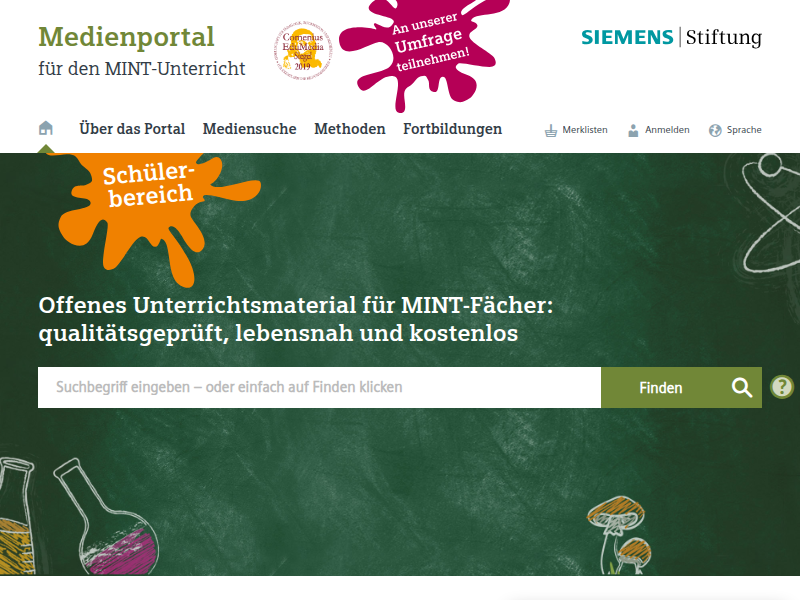
The Siemens Stiftung provides its own Media Portal for teaching materials, where teachers and other education advisors can download learning and teaching materials free of charge. The available media have been tested pedagogically and didactically, follow curriculum guidelines, and can be used directly in lessons.

Search result

https://medienportal.siemens-stiftung.org/portal/main.php?setlang=en&todo=metadata_search&crits%5Bforstudents%5D=1&crits%5Bmediatype%5D=500&crits%5Bmedialang%5D=de&view=students&searcharea=portal

The Siemens Stiftung provides its own Media Portal for teaching materials, where teachers and other education advisors can download learning and teaching materials free of charge. The available media have been tested pedagogically and didactically, follow curriculum guidelines, and can be used directly in lessons.

Search result

https://medienportal.siemens-stiftung.org/portal/main.php?setlang=en&todo=metadata_search&crits%5Bforstudents%5D=1&crits%5Bmedialang%5D=de&crits%5Btheme%5D=10&view=students&searcharea=portal

The Siemens Stiftung provides its own Media Portal for teaching materials, where teachers and other education advisors can download learning and teaching materials free of charge. The available media have been tested pedagogically and didactically, follow curriculum guidelines, and can be used directly in lessons.